Walking the path of the Dharma, how can you find the one true way, when there is no one way?
[HIT]
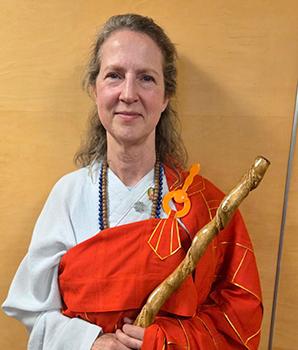
Holding an irregular stick, flickering candles, talking to all of you.
I recently read an article called, "Sitting with the Things I Came to Practice to Get Away From”. And I thought, “Ya, that sounds about right.”
Some of us enter the path of practice with a secret hope it will keep us from the pain that is part of human existence. That doesn’t happen.
The first Noble Truth, is the truth of suffering. The Pali word, dukkha, translated as suffering, can also be translated as distress or dissatisfaction. There are the many small ways we suffer when we don’t get what we want, lose something we want to hold onto, or encounter something we would really rather avoid. But the greatest suffering often comes from the truth of old age, sickness and death, both in our own lives and the lives of those we love.
I came to Buddhism in my early 30’s to reduce the pain and suffering of everyday life, including worries about being good enough, trying to find a way around uncomfortable social interactions, and the stress of transitioning from being a student to beginning a career. Yet, almost 20 years later when my mom began to experience dementia, I recognized while my practice did offer some support, the pain was beyond what I could bear. Because of that distress I was motivated to step outside of my comfort zone to participate in a weekend retreat where I met my teacher, Ven Myeong’il - and my practice has continued to grow since then.
It wasn’t until my practice deepened that it really sunk in-- the Buddha never suggested practice would remove our painful experiences. What he said was: “I make known just suffering, and the cessation of suffering.” [SN 22.86 Anuradha]. And to be clear, what is meant by “suffering” is the experience of the mind, not what is going on around us. Suffering is what is going on inside our minds.
What’s interesting is that while a secret hope to escape from pain can bring us to the Dharma, that same urge to escape from pain can also be a roadblock to authentic practice. At some point, hopefully sooner rather than later, we begin to sit with the very things we came to practice to get away from. It might be better to say we begin to “be with”, or “work with” the things we came to practice to get away from, because the most important part of our practice is what happens off the meditation cushion.
In the Compass of Zen, Zen Master Seung Sahn said:
“There are many, many people who believe that meditation is only about having some kind of stillness and bliss all the time… This kind of thinking is a very bad sickness. It is not true meditation because it becomes attached to some kind of situation. If you become attached to this kind of practice, your wisdom cannot grow up…So experiencing some kind of deep meditation practice is good. But a much more important training is keeping this mind when driving, eating, talking, working, and being with your family…If you can keep a not-moving mind while engaged in everyday activities, that is true meditation. That is true samadhi. It is the true nature of this practice.” (110)
As a very mundane example: If I am nervous about giving a dharma talk, telling myself, “It’s no big deal, why are you nervous?” or, “That’s stupid!”, that just doesn’t help at all. Trying to avoid or ignore the truth of my experience only makes me more tense! Instead, when I drop the story line and bring awareness to the felt sense of my body and mind with compassion and kindness, I can remember that fear of public speaking is very common, I’m not alone. It’s not something to be ashamed of, and there is nothing wrong with me.
Instead of letting an untamed mind run off down a road of proliferating anxious thoughts, the meditative skills of right effort, mindfulness and concentration allow me to take care of myself. Just paying attention. When I bring mindfulness to the body, I can choose to slow the breath, to slow the rate of my speaking, or to lower the pitch and tone of my voice. Relaxing the body and steadying the mind.
Connecting to any difficult experience with awareness and compassion, the experience itself is changed. Yongey Mingur Rinpoche has described a mind state of becoming “ok with not ok”. What he means is, when we stop needing to get rid of something, a sense of inner peace begins to grow, unrelated to outer circumstances. Until you experience something like that, it may be hard to appreciate how profound that kind of a realization can be.
When we can stop pushing away our own experience, we learn how to take better care of ourselves and others. Only when we stop judging or criticizing ourselves, can we truly stop judging or criticizing others. With wisdom and compassion, we can begin to reduce suffering for all beings.
It is a hard truth that the path of practice does not go AROUND the painful points, but straight through them. For most of us the impulse to escape a difficult situation carries some strong habit energy. But these painful points are precisely the guideposts we need to follow to deepen our practice. Our own unique sticking points are the gifts we receive that guide us in the path of practice. Each difficulty that presents itself is a doorway to further realization.
Our practice brings real transformation only when we are willing to engage with those difficulties we might wish to avoid. It heightens our compassion and awakens innate wisdom, and we become more and more capable of caring for ourselves and all living beings.
Walking the path of the Dharma, how can you find the one true way, when there is no one way?
[HIT]
How may I help you?